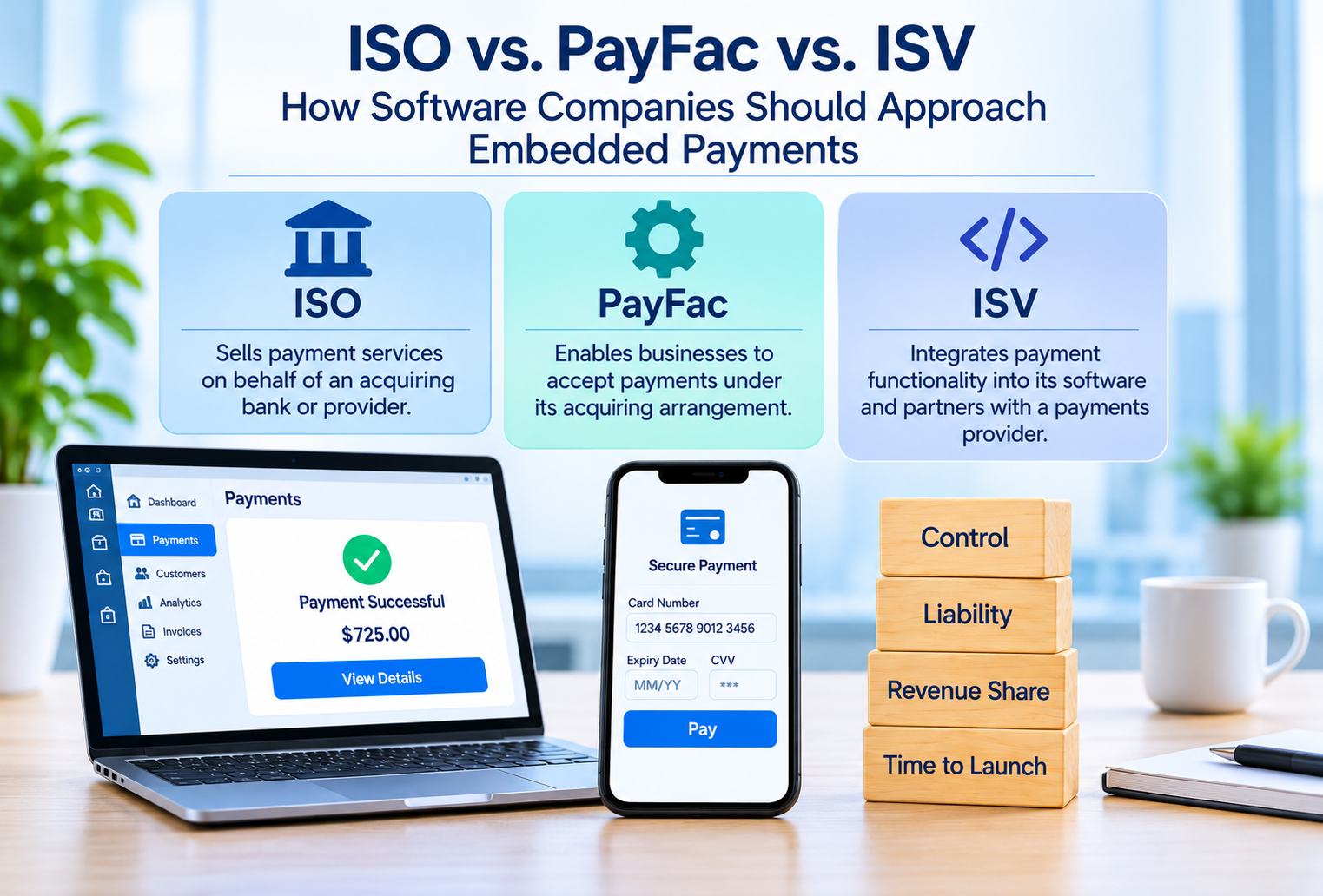
For most SaaS companies, the best route to ISV embedded payments is to start by partnering with an established payment processor or ISO, and to consider becoming a payment facilitator (PayFac) only once payment volume, margins and in-house risk management can support it. As software-as-a-service (SaaS) companies look for new revenue streams and ways to simplify customer workflows, embedded payments are becoming an important part of product strategy. For software founders and product leaders, choosing between an independent sales organization (ISO), a payment facilitator (PayFac) model, and an independent software vendor (ISV) payments partnership can affect revenue potential, operational responsibility, and time to market.
Understanding the differences between these structures can help software companies choose an approach that supports their growth without taking on unnecessary complexity.
What Is the Difference Between an ISO, a PayFac and an ISV?
An independent sales organization (ISO) is a company that markets payment processing services on behalf of an acquiring bank or payment provider. An ISO may help software companies connect their customers with payment services and earn referral fees or ongoing revenue shares. The processor or acquiring institution generally retains responsibility for merchant underwriting, subject to the agreements in place.
A payment facilitator (PayFac) enables eligible businesses, known as sub-merchants, to accept payments under the facilitator’s acquiring arrangement. This model can give a software company greater control over merchant onboarding, pricing and the payment experience. However, it also introduces additional responsibilities for underwriting oversight, fraud monitoring, compliance and financial risk. In the PayFac vs. ISO comparison, the core difference is who holds the merchant relationship and the risk: an ISO refers merchants to a processor that underwrites and holds each merchant account, while a PayFac boards sub-merchants under its own master merchant account and answers for onboarding, monitoring and losses across that portfolio.
An independent software vendor (ISV) develops software for businesses and can integrate payment acceptance directly into its product. An ISV is not automatically a payment facilitator. It can partner with a processor, ISO or PayFac to provide embedded payments without operating its own full payment facilitation program. With ISV embedded payments, customers can take payments, view transactions and reconcile without leaving the software. A growing middle option is PayFac-as-a-service, sometimes called a managed PayFac, in which a provider operates the facilitation program while the ISV controls the onboarding and checkout experience inside its own product.
PayFac vs. ISO vs. ISV: Control, Liability, Revenue and Time to Launch
The choice between these models depends on how much control a software company wants and how much operational responsibility it is prepared to manage.
Control: An ISO partnership can provide a straightforward route to payment services, although the processor typically controls much of the merchant relationship. An ISV working with a payments partner can integrate checkout, transaction reporting and billing into its software. A PayFac model can offer greater control over onboarding and pricing, subject to acquiring agreements and payment network rules.
Liability: With an ISO or partner-led ISV arrangement, the payments provider generally manages core processing and underwriting functions, although contractual obligations may still apply to the software company. A PayFac assumes more direct responsibility for sub-merchant oversight and may face losses arising from fraud, chargebacks or merchant failures. The precise allocation of liability depends on the agreement and program structure.
Revenue share: ISO arrangements may generate referral commissions or residual income. ISVs can negotiate revenue-sharing arrangements or earn fees from payment-related services. PayFacs may capture a larger portion of payment economics, but that revenue must be weighed against operating costs, compliance requirements, risk exposure and infrastructure expenses. For most ISVs, payment revenue starts as a share of the processing fees their customers generate and grows as the ISV takes on more of the onboarding and risk.
Time to launch: Referral and conventional partner integrations may be deployed relatively quickly, depending on approval and technical requirements. An embedded ISV integration requires development and testing, while launching a full PayFac program can take considerably longer because of underwriting, acquiring relationships, compliance controls and operational preparation, including registration with the card networks through a sponsor bank and PCI DSS validation as a service provider. Actual timelines vary by provider and business model.
When Should a Software Company Become a PayFac?
Becoming a PayFac may make sense when payments are central to a software platform’s value proposition, transaction volumes justify the investment, and the company has the resources to manage ongoing risk and compliance obligations.
For example, a vertical SaaS platform serving thousands of merchants may benefit from greater control over onboarding, payment pricing and transaction workflows. However, the additional revenue potential should be assessed against staffing, technology, compliance, chargeback management and potential financial losses.
For earlier-stage SaaS companies, partnering with an established payments provider is often a more practical starting point. It can help bring payments into the product while allowing the company to concentrate on customer acquisition, software development and retention.
“Most software companies don’t need to become a PayFac on day one,” said Joshua Benedetti, CEO of CARDZ3N, a Las Vegas–based merchant services provider specializing in high-risk payment processing and B2B payment technology. “The smarter path is to embed payments through a partner, learn your merchants’ risk profile and volume, and take on more of the program only when the economics and your compliance team are ready.”
A Practical Decision Framework
Before selecting an approach, founders and product leaders can ask four questions:
Are payments central to the product? If they are secondary, a referral or processor partnership may be sufficient. If they are integral to daily workflows, embedded payments may offer greater value.
How much control is necessary? Companies seeking a branded checkout and integrated reporting may not need a full PayFac structure.
Can the business manage risk? Assess the available compliance expertise, capital, fraud controls and operational resources before accepting greater responsibility.
Does the revenue justify the investment? Compare expected payment volume and revenue share against integration costs, ongoing expenses and potential losses.
Rule of thumb: if the answer to either the risk question or the revenue question is no, start with a partner-led ISV integration and revisit the PayFac decision as volume grows.
The decision should be based on the company’s current scale and strategic priorities, rather than on the assumption that greater control will automatically produce higher profits.
Building an ISV Embedded Payments Strategy
An effective embedded payments strategy requires more than adding a checkout interface. Software companies should evaluate API and SDK support, merchant onboarding, recurring billing, settlement reporting, fraud prevention, chargeback management and the flexibility to accommodate future growth.
CARDZ3N provides payment processing and ISV integration options for software businesses seeking to incorporate payment functionality into their products. Companies exploring an ISV payment processor or embedded payments for SaaS can compare integration approaches through CARDZ3N’s ISV payment processing options.
Ultimately, the choice between an ISO partnership, an ISV integration and a PayFac model depends on a company’s desired level of control, resources and appetite for risk. For many SaaS businesses, partnering first and expanding payment responsibilities as transaction volume grows can provide a measured path toward monetizing embedded payments.
About CARDZ3N
CARDZ3N is a Las Vegas-based merchant services provider specializing in high-risk payment processing and B2B payment technology, serving merchants in the USA, Canada, the UK and the EU. Learn more at cardz3n.com.

Daily magazine for entrepreneurs and business owners