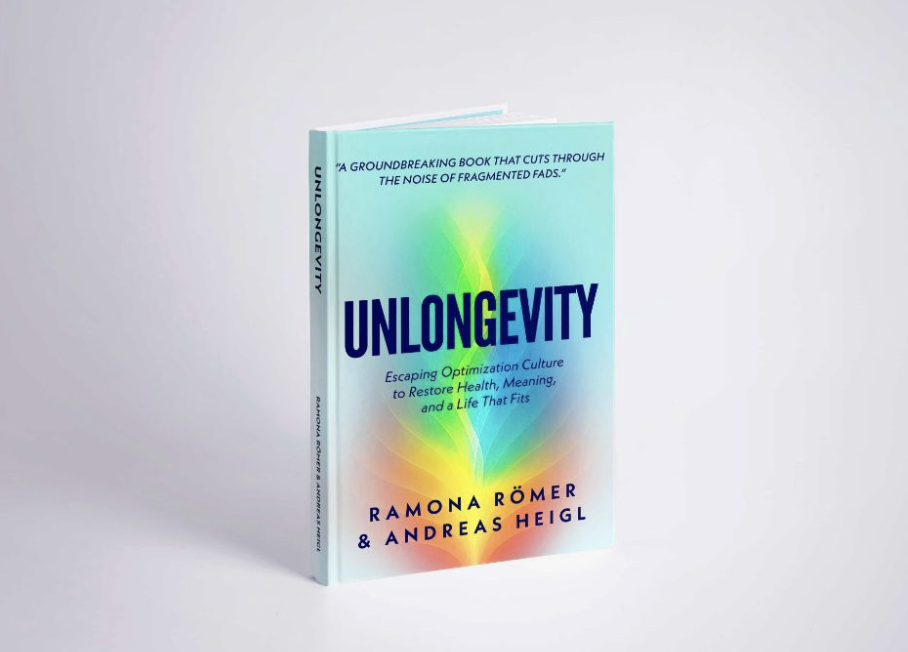
Unlongevity: Escaping Optimization Culture to Restore Health, Meaning, and a Life That Fits by Ramona Römer and Andreas Heigl arrives at an interesting moment in the broader conversation about health and longevity. We have never had more access to information about how to live longer. Wearables can track sleep, heart rate, activity, recovery, and other markers around the clock. Genetic testing can offer increasingly detailed information about individual biology. Medical technology continues to advance, while the wellness industry constantly introduces new protocols, supplements, routines, treatments, and theories promising to help us feel better and perform at a higher level for longer.
And yet, for all of this information, many people seem to be left with a surprisingly difficult question: What are we actually supposed to do with all of it?
That question sits at the center of Unlongevity, which takes aim not at the desire to live a longer and healthier life, but at the increasingly complicated culture that has grown around that desire. Ramona Römer and Andreas Heigl argue that longevity has become closely associated with optimization, measurement, intervention, and continual self-improvement. The assumption seems straightforward: if something can be measured, it can be improved, and if it can be improved, we should improve it. But the authors are interested in what happens when that logic is applied to an entire human life.
The result is a book that asks readers to consider whether the pursuit of health can sometimes become disconnected from the actual experience of living.
Rather than presenting longevity as a checklist of behaviors, Unlongevity takes a broader view. The book considers physical health alongside emotional well-being, relationships, purpose, environment, personal circumstances, and the ways these factors influence one another. Its central argument is that the human being cannot always be understood by separating life into neat categories. What happens emotionally can influence the physical experience of health. Relationships can affect stress and well-being. Purpose can shape motivation and engagement. The environment in which someone lives can influence habits, energy, and quality of life. These elements continually interact, even when modern health systems and wellness culture tend to examine them separately.
This idea of interconnectedness is one of the book’s strongest contributions.
Modern health advice often arrives in fragments. One expert discusses nutrition. Another focuses on exercise. Another examines sleep. Another discusses hormones, metabolic health, stress, supplements, or biomarkers. There is value in specialization, and Unlongevity does not dismiss the enormous progress that specialization and scientific research have made possible. Instead, Römer and Heigl ask readers to consider what may be lost when specialized knowledge is mistaken for a complete understanding of the person.
A laboratory result can provide useful information. A wearable can reveal patterns. A scan can show something that would otherwise be invisible. Medical intervention can be transformative. But none of those things, on their own, necessarily explain what a person needs in the context of an entire life.
That distinction gives the book much of its intellectual foundation.
One of the most compelling aspects of Unlongevity is its resistance to the idea that more is automatically better. In the current longevity landscape, there is an understandable temptation to accumulate interventions. A person interested in living longer might begin by changing their diet, then add supplements, track sleep, monitor exercise, investigate biomarkers, explore new testing, experiment with various routines, and continue adding strategies as new information becomes available.
Each individual decision may appear reasonable. The problem is that the overall picture can become increasingly complicated.
At some point, the pursuit of better health can begin to resemble a second full-time job.
Unlongevity recognizes this tension and asks a deceptively simple question: What if the answer is not always to add something else?
That question feels particularly relevant in a culture where optimization has become almost synonymous with responsibility. People are frequently encouraged to improve their productivity, appearance, fitness, sleep, diet, careers, relationships, finances, and mental performance. There is an implicit expectation that every area of life can and should be optimized.
The authors push back on that expectation.
Their argument is not that people should stop caring about their health or abandon useful medical and technological advances. Rather, they challenge the assumption that health necessarily improves in direct proportion to the number of interventions someone adopts. The more important question becomes whether a particular intervention fits the individual, their circumstances, their timing, and their broader goals.
That shift from quantity to context is central to the book.
It also changes the meaning of longevity itself.
If longevity is defined primarily as extending the number of years someone is alive, then the conversation naturally gravitates toward measurable biological outcomes. But if longevity is understood as the opportunity to remain engaged with life over time, then the discussion becomes considerably larger. It includes questions about purpose, relationships, contribution, curiosity, emotional fulfillment, and the ability to experience one’s life as meaningful.
This is where Unlongevity moves beyond a conventional health book.
The authors are ultimately less interested in helping readers become perfect versions of themselves than in asking whether the constant pursuit of improvement can sometimes distract people from the life they are actually trying to live. There is a subtle but important difference between caring for oneself and perpetually trying to become someone else.
The book’s critique of optimization culture is especially effective because it does not require the reader to reject ambition. In fact, the intended audience appears to be people who are already engaged, curious, informed, and proactive about their health. These are not readers who need to be convinced that health matters. They may instead be people who have encountered so much information that deciding what matters has become the harder task.
For that audience, Unlongevity offers a useful reframing.
Instead of asking, “What should I do next?” it encourages a person to ask, “Why am I doing this, and how does it fit into the larger picture of my life?”
That is a more difficult question, but potentially a more meaningful one.
Another particularly interesting idea is the authors’ suggestion that the body may not always be the first place where an imbalance becomes apparent. Physical symptoms and measurable biological changes can be important signals, but people may experience other signs long before a conventional measurement identifies a problem. Changes in mood, energy, relationships, stress responses, motivation, or a sense of disconnection can all be meaningful parts of the larger picture.
This perspective does not make emotional or relational experiences substitutes for medical care. Instead, it argues for taking them seriously as part of understanding the person as a whole.
That distinction matters because the modern desire for objective data can sometimes lead people to discount experiences that are difficult to quantify. If a wearable says someone slept well but they feel exhausted, which piece of information should receive more attention? If a laboratory result falls within a reference range but someone feels that something in their life is fundamentally out of balance, is the number sufficient to explain the experience?
Unlongevity does not necessarily offer simple answers to these questions. Its larger point is that the questions themselves deserve to be asked.
The book’s title is therefore particularly effective. “Unlongevity” suggests a departure from the conventional longevity conversation rather than a rejection of longevity itself. It implies stepping outside a narrow framework in order to reconsider what the pursuit of a longer life is actually for.
That distinction gives the book a broader philosophical dimension.
Living longer is not automatically the same thing as living better. Extending a lifespan may be a worthwhile goal, but the quality and meaning of those additional years matter just as much. A life organized entirely around preventing decline can become strangely disconnected from the present. If every decision is made in service of a future version of oneself, there is a risk that the current life becomes little more than preparation.
This is perhaps where the book’s critique of optimization becomes most provocative.
Optimization is inherently future-oriented. There is always something next: the next goal, the next metric, the next improvement, the next version. But a meaningful life cannot necessarily be reduced to an endless sequence of improvements. Some experiences are valuable precisely because they are not optimized. Relationships require time. Creativity requires uncertainty. Rest is not always productive. Purpose cannot always be measured. And fulfillment does not necessarily arrive when every biological marker has been improved.
Römer and Heigl make the case for leaving room for those less quantifiable dimensions of life.
The book is also compelling in its insistence that there cannot be one universal formula for living well. People move through different stages of life, and what works at one point may not work at another. Circumstances change. Priorities change. Bodies change. Relationships change. Professional responsibilities change. What genuinely supports health therefore has to be understood within context.
That makes Unlongevity less of a conventional how-to book and more of a framework for thinking.
This is also one of the book’s potential challenges. Readers looking for a highly structured longevity protocol may find its approach less immediately satisfying. There is no single checklist that can eliminate uncertainty. There is no universal prescription that applies equally to everyone. The book asks the reader to participate in the process of interpretation rather than simply follow instructions.
But that is also precisely what makes the book distinctive.
In an industry filled with increasingly elaborate systems for telling people what to eat, how to sleep, how to exercise, what to measure, and what to add to their routines, Unlongevity makes a case for developing better judgment. It encourages readers to become more attentive to context rather than simply more knowledgeable about interventions.
That may ultimately be its most valuable message.
The longevity conversation is unlikely to become simpler. Scientific discoveries will continue to produce new possibilities. Technology will continue to generate new forms of data. Medical interventions will continue to evolve. Consumers will continue to encounter competing claims about what they should be doing to protect and improve their health.
The challenge, then, is not necessarily to know everything.
It may be to know what matters.
Unlongevity argues that answering that question requires looking beyond isolated biomarkers, trends, and optimization strategies and returning to the larger human context in which health actually exists. A person is not a collection of metrics. A healthy life is not simply a successful optimization project. And longevity, if it is going to mean something beyond a number of years, has to include the question of what those years are for.
That makes Unlongevity a timely and thoughtful contribution to the conversation around health and longevity. Its greatest strength is not that it provides another set of answers, but that it encourages readers to reconsider the questions they have been asking.
In a culture that constantly tells us to do more, measure more, improve more, and optimize more, there is something refreshing about a book that asks us to pause.
Perhaps living well for a long time is not simply about adding more years to life.
Perhaps it is also about making sure that the life we are extending is one we actually want to be living.
Dive into Unlongevity here: unlongevity.com

Daily magazine for entrepreneurs and business owners