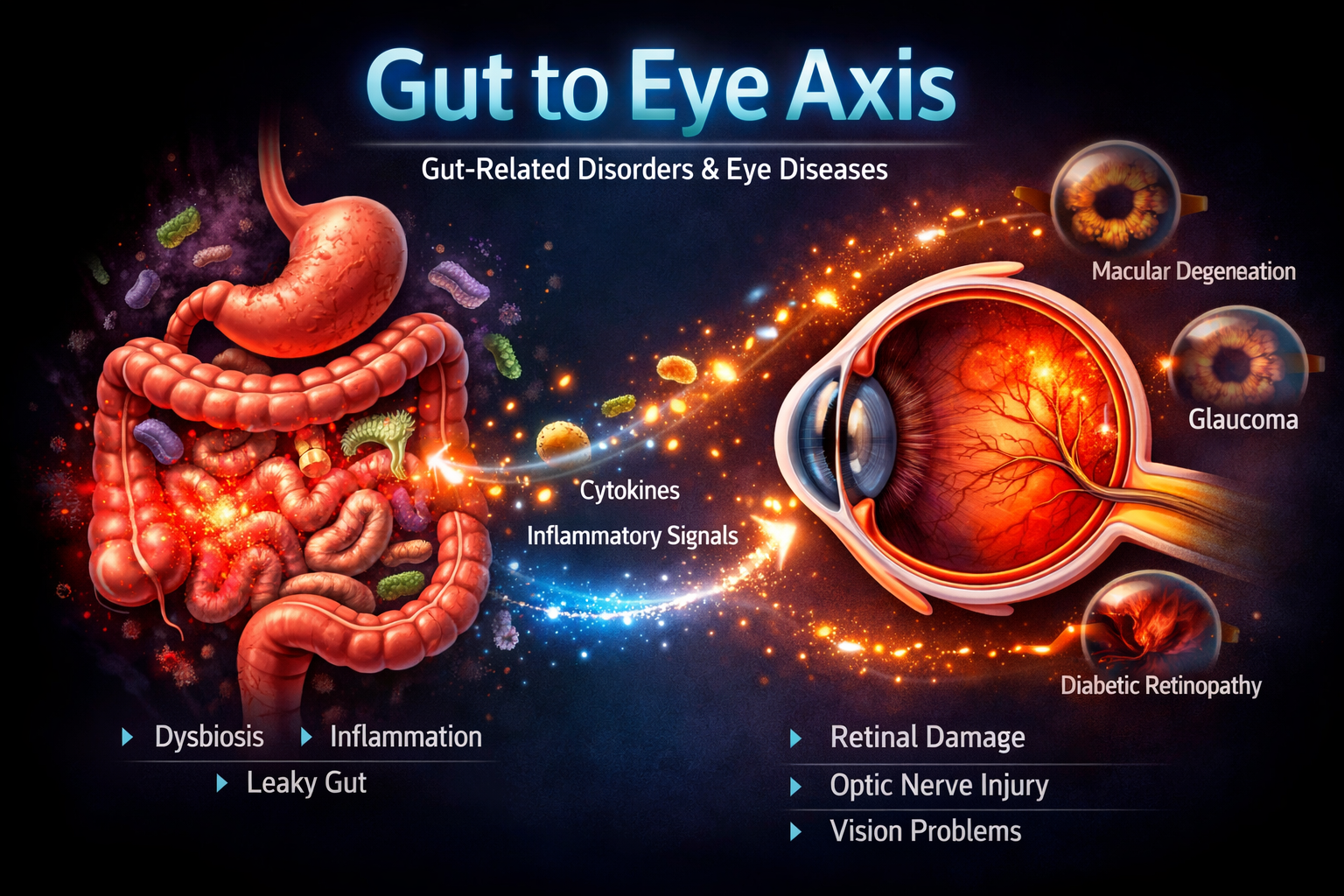
For decades, eye diseases such as dry eye were treated primarily as local problems—managed with drops, ointments, and surface-level interventions. Emerging research now challenges this narrow view. A growing body of scientific evidence points to a powerful gut–eye axis, showing that digestive health, immune regulation, and systemic inflammation profoundly influence ocular health.
A recent large-scale cohort study published in Scientific Reports (Nature) adds important clinical weight to this concept. The study demonstrated that individuals who underwent total gastrectomy had a significantly higher risk of developing dry eye disease, highlighting that major disruptions to gut anatomy and function can translate into ocular surface pathology. This research reinforces a broader paradigm shift: eye health is inseparable from whole-body health.
At Netra Eye Institute, this emerging science aligns closely with an integrative philosophy that views vision as a reflection of systemic balance—particularly involving digestion, inflammation, circulation, and nervous system regulation.
Modern Science and the Gut–Eye Axis
The gut microbiome plays a central role in immune modulation, metabolic signaling, and inflammatory control. When the gut environment is disrupted—through surgery, chronic stress, poor diet, medications, or illness—systemic inflammation can increase. Microbial metabolites, cytokines, and immune mediators circulate throughout the body, affecting distant organs, including the eyes.
In dry eye disease, these systemic influences can:
- Promote ocular surface inflammation
- Disrupt tear film stability
- Alter meibomian gland function
- Increase oxidative stress and immune reactivity
The Nature study’s findings suggest that dry eye may, in some cases, be a downstream manifestation of altered gut physiology, not merely a localized tear deficiency. This insight provides a scientific foundation for integrative and preventive approaches to eye care.
Traditional Chinese Medicine (TCM): An Ancient Gut–Eye Framework
Long before the microbiome was discovered, Traditional Chinese Medicine (TCM) described functional relationships between digestion, systemic balance, and the eyes.
1. Spleen–Stomach and Fluid Metabolism
In TCM, the Spleen and Stomach govern digestion and the production of Qi and Body Fluids. When digestion is weak, the body struggles to generate and distribute nourishing fluids, leading to dryness throughout the system—including the eyes.
Patients with poor appetite, bloating, loose stools, fatigue, or irregular eating patterns often present with dry eye symptoms. From a TCM perspective, the eyes are not drying out randomly—they are reflecting impaired internal fluid production and transport.
2. The Liver System and the Eyes
TCM states that the Liver “opens into the eyes.” This concept refers to the Liver’s role in nourishing the eyes with blood, supporting circulation, and regulating stress responses. Chronic emotional stress, irregular routines, and poor sleep can lead to Liver Qi stagnation, which may transform into heat and inflammation, worsening eye irritation, redness, and burning.
3. Heat, Inflammation, and Dryness
Many dry eye patients exhibit inflammatory signs—burning, redness, lid margin disease. In TCM, these often correspond to Heat or Damp-Heat patterns, frequently aggravated by diet (alcohol, spicy or greasy foods), stress, and sleep deprivation.
TCM Lifestyle Management: Treatment Beyond the Eye
TCM emphasizes lifestyle as a primary therapeutic tool, not supportive care. Key principles include:
- Regular, warm, cooked meals to support digestion
- Reducing inflammatory and “drying” foods when symptoms flare
- Stress regulation through breathing, movement, and rhythm
- Consistent sleep schedules to rebuild fluids and reduce internal heat
- Conscious screen use to limit fluid depletion and eye strain
By stabilizing digestion and nervous system balance, TCM seeks to treat the root pattern, not just the ocular surface.
Ayurveda: Digestive Fire and Ocular Balance
Ayurveda similarly places digestion at the center of health. It describes disease through imbalances in doshas—Vata, Pitta, and Kapha—and impaired Agni (digestive fire).
1. Vata and Dryness
Dry eye strongly resembles a Vata imbalance, characterized by dryness, roughness, instability, and sensitivity. In Ayurveda, Vata disturbances often originate in the colon and nervous system, spreading dryness to peripheral tissues such as the eyes.
2. Pitta and Inflammation
Burning, redness, and irritation reflect Pitta excess, associated with heat and inflammation. Elevated Pitta can inflame the ocular surface, especially when combined with stress, overheating, alcohol, or spicy foods.
3. Ama: Metabolic Inflammation
Poor digestion leads to Ama, a toxic, inflammatory byproduct that disrupts immune balance and tissue health. Ama is conceptually similar to modern ideas of metabolic inflammation and immune dysregulation linked to gut imbalance.
Ayurvedic Lifestyle Management: Restoring Balance
Ayurveda treats dry eye by restoring digestive strength and calming the nervous system:
- Warm, nourishing, moist foods to pacify Vata
- Consistent daily routines for meals and sleep
- Reducing excessive stimulation, late nights, and overwork
- Cooling strategies when inflammation dominates
- Stress reduction through yoga, breathwork, and meditation
These strategies aim to stabilize systemic dryness and inflammation before they manifest in the eyes.
Where Ancient Wisdom Meets Modern Science
What modern gut–eye research now confirms is what TCM and Ayurveda have long observed clinically: Chronic eye conditions often reflect systemic imbalance.
Diet, sleep, stress, digestion, and lifestyle patterns influence:
- Gut microbiome composition
- Immune and cytokine signaling
- Oxidative stress levels
- Neurovascular regulation
- Tear film and ocular surface integrity
Addressing these upstream drivers can improve resilience, reduce flare-ups, and support more sustainable outcomes.
Netra Eye Institute: A Systems-Based Vision for Eye Care
Netra Eye Institute integrates this evolving science with time-tested holistic frameworks by:
- Looking beyond symptoms to identify systemic contributors
- Incorporating lifestyle, nutritional, and metabolic considerations into care
- Educating patients on sustainable habits that protect vision long-term
- Combining modern diagnostics with integrative therapeutic strategies
This approach does not replace conventional eye care—it completes it, recognizing that lasting eye health often depends on restoring balance throughout the body.
The gut–eye axis represents a new frontier in ophthalmology—one that validates ancient medical wisdom through modern research. Dry eye and other chronic ocular conditions are increasingly understood not as isolated eye problems, but as reflections of digestive health, immune regulation, and lifestyle patterns.
By bridging cutting-edge science with holistic traditions, Netra Eye Institute exemplifies the future of eye care: integrative, personalized, and rooted in whole-body health—because how you digest, live, and restore balance ultimately shapes how you see.
Netra Restoration Therapy (NRT)
Our signature Netra Restoration Therapy is a unique treatment method available exclusively at Netra Eye Institute, which has shown to halt Glaucoma progression, improve visual field, reduce foggy/hazy vision, improve contrast sensitivity and reduce glare.
The Mechanism of Action (MOA) of Netra Restoration Therapy works by enhancing ocular blood flow through the regulation of vascular function, increasing neurotrophin levels and neuroprotection, and reducing ferroptosis, oxidative stress and ocular inflammation.
This creates a healthier retinal environment that supports optic nerve resilience and halts the progression of glaucomatous damage.
NRT Treatment Benefits
The potential for visual improvement depends on the severity of optic nerve damage and the stage of glaucoma at the time of treatment. Taking these factors into account, our therapeutic approach has been shown to result in:
- Stop Vision Loss Progression
Stops glaucoma vision loss progression by addressing contributing factors beyond eye pressure. - Improved Visual Field
Improvement in visual field by restoring dormant and unhealthy retinal cells - Improved Visual Acuity
An improvement of at least one line on the distance and near vision eye chart. - Improved Contrast Sensitivity
Improved contrast vision, making it easier to distinguish shapes, edges, and details. - Increased Visual Brightness
Improvement in color, brightness perception and clarity making it easier to see in low-light or nighttime conditions, thereby supporting safer mobility and daily activities. - Reduced Glare and Light Sensitivity
Reduced glare, less light sensitivity, and improved comfort in bright environments, such as sunlight, headlights, or digital screens. - Reduced Eye Strain/Pain
Patients experience considerable reduction in eye pain and eye strains.
References: Lee, Y., Yoo, D.M. & Choi, S.H. Long-term risk of dry eye disease following gastrectomy and colectomy in a nationwide cohort study. Sci Rep 16, 1530 (2026).
Netra Eye Institute
5001 Hadley Rd, Ste 210,
South Plainfield, NJ 07080
TEL: (732) 503 9999
FAX: (732) 333 6473
https://www.netraeyeinstitute.com

Daily magazine for entrepreneurs and business owners